Friday, January 8, 2021

German Symphony Trombone by Holton 1915

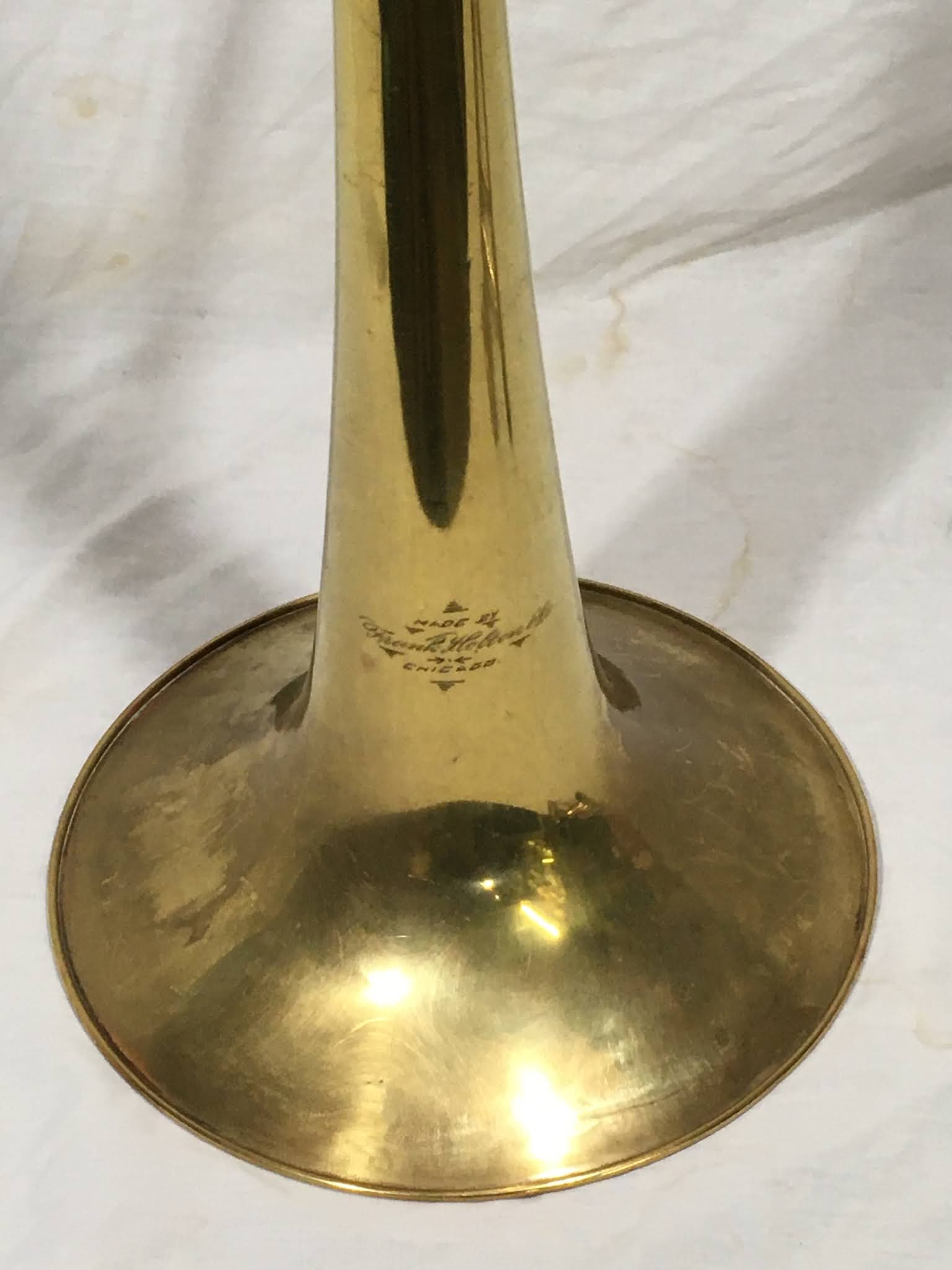
Here is a rare bird, a "German" trombone made by an American firm, Holton, in 1915.  Some orchestra conductors in the U.S. at the turn of the 20th century were asking for bigger trombone sounds to suit their tastes and literature, and nothing makes big sounds like big instruments.  German-made trombones of the time, often having a wider bore and larger bell than equivalents from French, English, and American makers, thus came into use.  At first, these instruments were carried to the U.S. by immigrants and copied in small numbers (ie: Lehnert, Moennig, Martin).  Later, as demand increased, they were imported, branded by the maker (ie: Penzel, Heckel, Schopper) or by the distributor (Wunderlich).  Without a doubt there was a growing call for this instrument, and Frank Holton Co. of Chicago would offer the type as a domestically-produced option.

Looks like business

Holton "Special" trombones were produced in multiple sizes, the largest, #6 "large" bore with 8-1/2 inch bell, being offered as early as 1904 (Holton Harmony Hints 1/1).  These instruments were recommended as "especially well-adapted for bass trombone in band."  Endorsements by members of Boston Symphony Orchestra and Chicago Symphony are printed in Holton literature as early as 1911 (H.H.H. 8/8), encompassing tenor and bass trombonists and conductors.  At that time it was claimed "The Holton German Symphony Model is the only American-made trombone that has made good in the principal symphony orchestras."  L.S. Kenfield, bass trombonist of the Boston Symphony, endorses this instrument built with "F" attachment.  In a 1924 Holton catalog the F attachment is listed as an option for $25.

In Exposition Year Catalog of Holton Band Instruments (1915), the "Special Symphony Model" is listed as having a #6 bore and sold for $48 in brass finish without a case.  It is presumed that the present instrument is that model or a variation thereof.  It is unknown what relation the "German Symphony Model" of 1911 has to this "Special Symphony Model" of 1915, but one could surmise that anti-German sentiment in the years running up to WW1 had been considered by the marketing department.


BSO members around 1920.  Carl Hampe's instrument is clearly visible;
it has a wide slide, and his right hand is resting on the tuning slide brace.

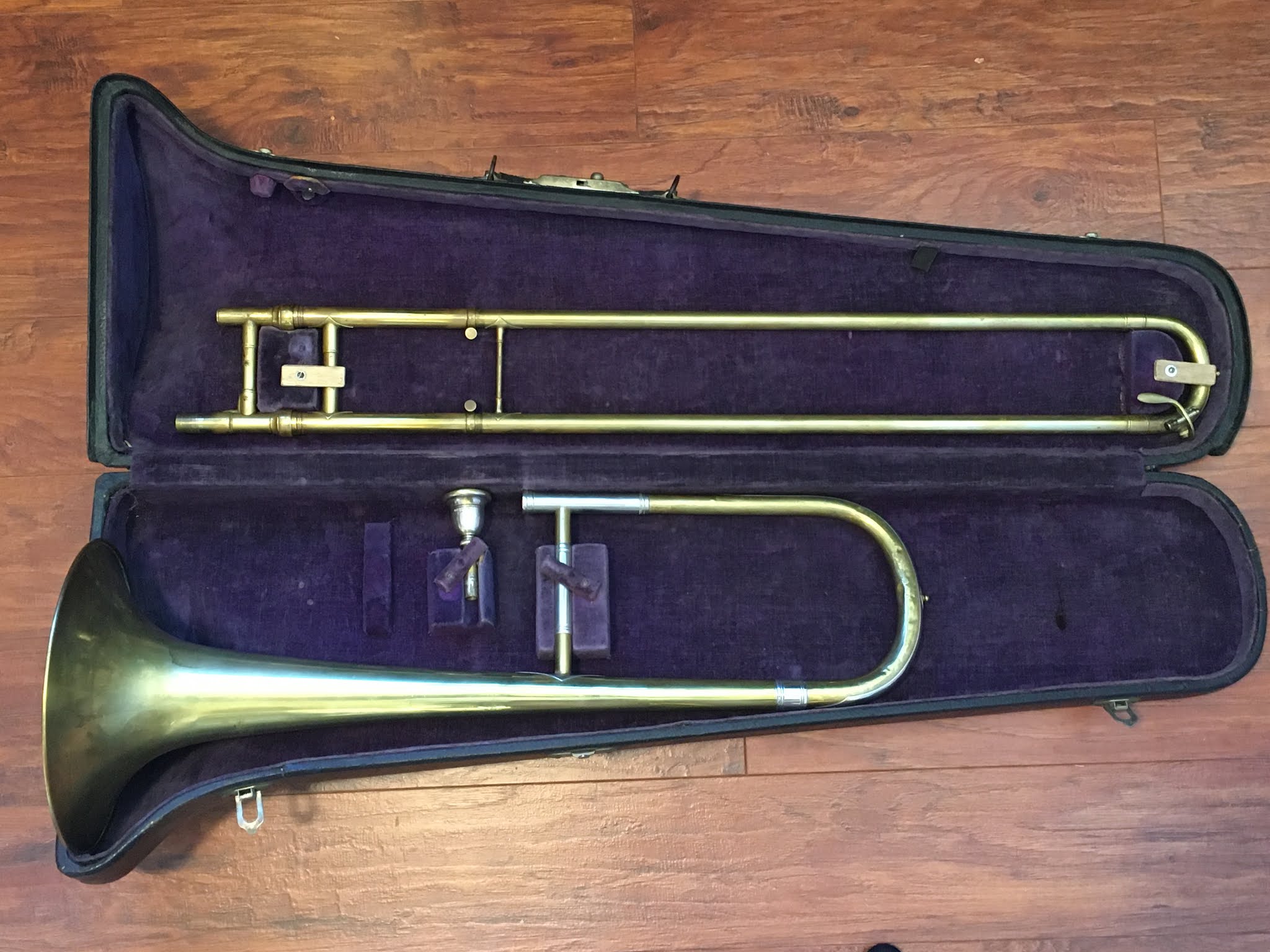
This horn was made in Chicago, Illinois, USA.  It plays in Bb, modern pitch, is built with a dual .530/.559-inch bore, and has a 9-inch lightweight bell.  Abandoned from the traditional German model are the wide, floating slide, and cork barrels with springs (it is interesting to note that modern orchestral trombones have wide slides with cork barrels, and sometimes springs).  A wide nickel garland on the bell is occasionally added by German makers; this horn does not have one.  Also, the often-outrageous nickel snake decorations on the bell and slide bows have been dropped in favor of small knobs.  Additions to the traditional model include a tuneable slide, a lead pipe/receiver, and a spit valve (in all fairness, some of these features were also appearing on German-made instruments of the time).  There is no bell nut or slide lock; you must hold the horn together with your left hand at all times.

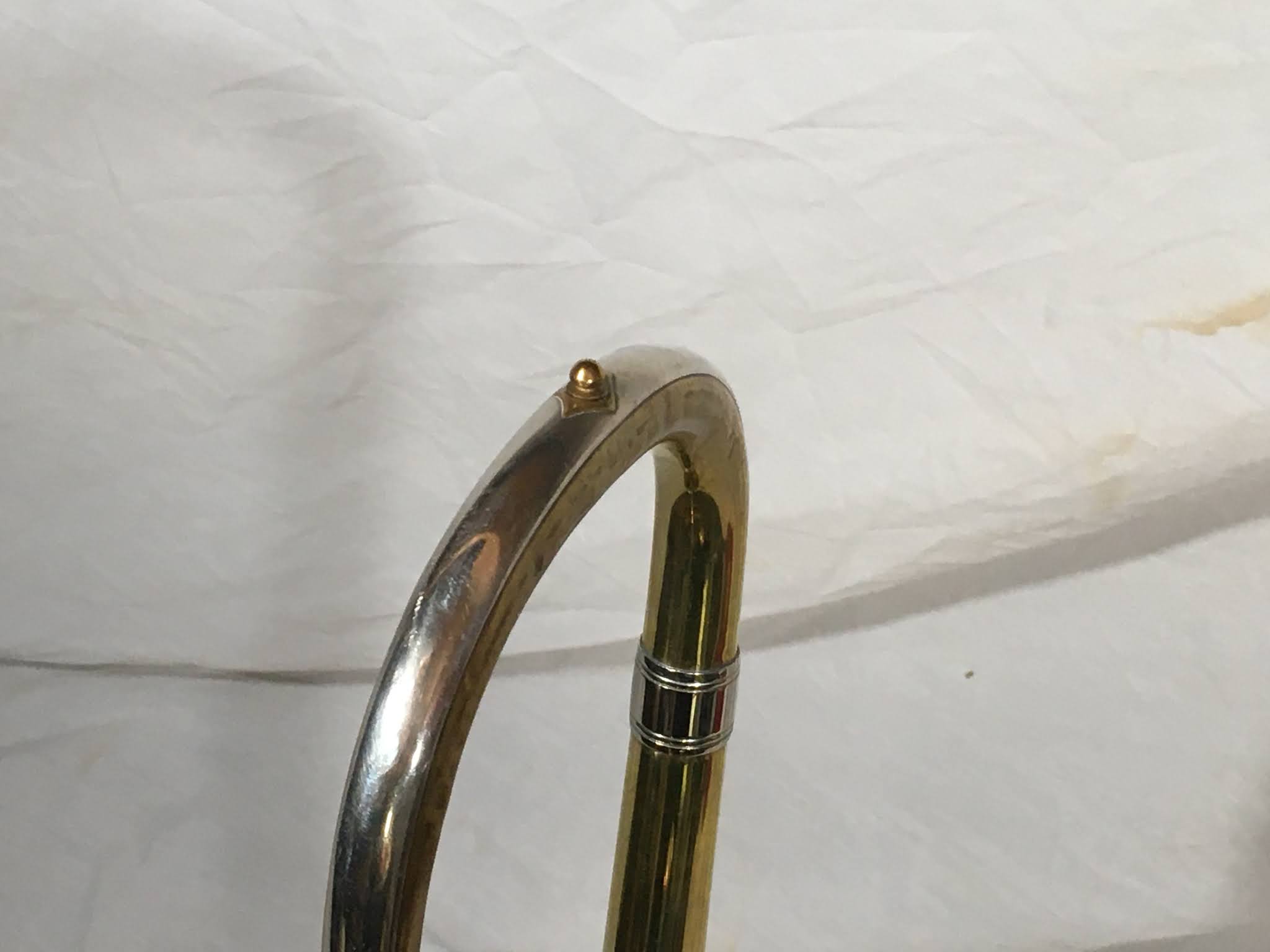
no snakes

snakes

The mouthpiece is not original; it is a (fairly) modern Mirafone E56 with a medium shank.  This is not the "euro" shank as found on British and Willson euphoniums; it is slightly smaller and longer, for Mirafone eufoniums.  Fortunately, it seems a good match for this instrument; besides having the correct taper, it is reasonably wide and deep like you would expect of a orchestral mouthpiece.


The slide goes in-and-out alright, I guess, for an old horn, maybe I would rate it a 5/10 for playability, and of course it could be improved with a slide job, but even then it will have one main, glaring, terrifying, fatal, flaw:  it doesn't stay connected to the bell.  The huge, tall, heavy, bell, with no nut, and no counterweight, and a taper that only overlaps about an inch, will. not. stay. attached. to. the. slide.  You put the horn together, and it seems tight, but it's not, it slips.  You screw it on tighter next time and you think it might be OK, and it comes loose.  Surprise!  Right before your big entrance.  You have to keep your thumb on the bell brace at all times, or it falls off your shoulder KLANG onto the floor.  It waggles loose while you're maneuvering the slide back in from long positions.  Pick it up off your trombone stand and it closes KLINK on the slide and leaves a dent.  Indeed, as I look at the slide closely I see a bunch of parallel dents, some ironed-out, extending along the top of the outer slide, from bell-position back, from this fun folding action.  

left:  period German slide (.551/.551); wide and long, with a generous tenon
right:  Holton slide (.530/.559); narrow, with a dinky tenon

But there's more; the slide is narrow, so you have little leverage over that big bell.  It hurts your entire left arm to hold the instrument; it's tipping over, pulling forward, falling apart, and hurting your wrist, and your shoulder is tired, and your thumb is going to sleep, and your fingers are cramped together so they don't get bitten, and that slide, arg.  KLANK.  This may be how the horn has survived for one hundred and five years; it's barely playable, really.  Only by the slimmest chance it hasn't been thrown out a window.

Two 1915 Holton trombones

How does it play?  The sound, it has it; heroic, wide, projecting, prone to over-volume.  A full, robust, tenor voice.  High notes are playable but precarious.  Soft passages have a miraculous, airy sound when you can get the notes to speak; despite the thinness of the brass and light bracing, the huge bell seems to take a moment to start up, so it is not the most "responsive."  You have to think a little ahead to play in time.  And there is a panicky quality to the sound as you play louder; the instrument is resistant, so you have to play super-focused otherwise the sound get chiffy and every third note splits.  It improves with practice, as usual, and certainly a more-refined mouthpiece would also help.  I like to play some Wagner excerpts on a horn like this, also Mahler.  When playing the Mahler 3d Symphony "sentimental" solo on a period horn (this and ACTUAL German instruments), I discovered: playing the final notes (B-b-F) you can't get the slide from seventh to fourth and then back to sixth, Etwas Drangend, without completely disrupting your face and turning it into a splat-chiff-claaaaaaam.  We in 2020 are accustomed to perfect slides, but with an instrument of the time the maneuver is barely possible, mechanically; once you are in seventh you have to stay in seventh until there is a space to move.  The passage must be played in positions 7-7-6.  Mahler likely knew these three notes had to be played a certain way, which gave the passage a certain sound: terror, desperation, abandon, finality?  What are those three notes, what do they mean?  Try it this way with your modern horn (7-7-6), and you'll know something new about how it can sound.  The low range is very nice on this horn, big and round, with pedal notes that are easy to fake.

This promising but rather clumsy first effort showed the way for manufacturers of post-WWI years, as Holton, Olds, King, York, Martin, and others offered large USA-built tenor instruments.  Evolution took its course, and with refinements to tuning, ergonomics, and mechanics, ultimately there developed a modern American type of orchestral tenor, typified by Conn 8H and Bach 42.

left: German tenor trombone, anonymous ca. 1900
center: Holton Symphony, 1915
right: Bach/Shires 42, 1983

left:  Holton Symphony
right: Bach 42


Saturday, May 30, 2020

Denver Protest May 30

A little before the curfew started.  Something is going on by the capitol involving explosions and smoking projectiles being tossed back and forth.

Thursday, December 5, 2019

Wintertime Year-round

July 2019 Denver Hail
Ouch

December 2019 Denver Snow
Powder Day


Friday, August 30, 2019

Tuesday, May 14, 2019

REI Flagship Confluence Park

Confluence Park, looking North from the Speer Blvd bridge.  In this view, Cherry Creek flows into South Platte River, and their respective trails converge as well.  Globeville is just down the river, Auraria sprawls across the bottoms to the south, Lodo is near, as are Coors field and Broncos stadium and the Capital.  Also, I25 and an old rail line.  The feeling of "place" here is strong; I suspect humans have been meeting at and living in and passing through this spot for thousands of years. You can get anywhere from here; to the left is a bike trip south up the river all the way to Waterton Canyon, which connects to the Colorado Trail, Leadville, Durango, etc.  Turn right here for Sterling, Ogallala, Lincoln, all points East.

Northeast Portal.  Add a bell tower and some stained glass and you have a Romanesque cathedral. 


Waterton Canyon Bear


August 2018

Saturday, March 30, 2019

Thoughts on Great Bikes


A new Waterford and an old Gordon, a day at the shop working on great bikes.  I am reminded that a great bike is always a great bike. What made a bike great thirty years ago still makes the same bike great today. Craftsmanship. Care. Design and proper use of materials. Hand Work, not machinery or computers. Newness doesn't make a bike great, Carbon Fiber doesn't necessarily make a great bike. Steel doesn't always make a great bike. Great bikes aren't cheap, but expensive bikes aren't always great. If you buy a great bike today it will still be a great bike in thirty years. A mediocre bike today will still be a mediocre bike in thirty years, if it lasts that long. Who wants to ride a mediocre bike for thirty years? Who among us has bought a mediocre bike thinking it was great? Who among us has sold a great bike in order to finance a new bike, only to find out the difference between "great" and "new?"

What makes a great bike?

1. Fit. The rider can embrace the machine without strain, and function with it as if one.

2. Design. The bicycle has features demanded by its intended use.

3. Handling. The frame is straight. The fork is straight and complements the geometry of the frame. The bike goes where you look/lean/steer.

4. Execution. Craftsmanship. Attention to detail. The closer you get the better it looks. Even this beat-up old Bruce Gordon is beautiful when you get right up close to it.

5. Feel. The final personal judgment. The bike feels good when you ride it. Every time. At the end of the ride just as at the beginning. The flex of the frame is matched to the weight and style of the rider. A bike which is great for one rider might be merely good for the next. No particular feature or characteristic sticks out-you can't describe it as "light" or "heavy" or "rough" or "quick" or "chattery" etc. Any single dominant trait will detract from another. The bike is balanced. A great bike is both heavy AND light, depending on the demands put on it in use. A great bike is both quick AND stable. A great bike disappears to you in that it has no distracting manners, it does just exactly what it is expected, when it is expected, as many times in a row as necessary, without drawing attention to itself. It is quiet, competent, sublime.

You can't tell a great bike by riding it once. You have to own it. Use it repeatedly, in different situations, and come to know it.

One of the good bikes that I own, all I can think about when I use it is, "stiff." When turning, "stiff." Accelerating, "stiff." Rough pavement, "stiff." Twenty miles later, "stiff." Looking at the bike, seeing the components, weighing it, you'd think "great bike." But no, merely good.

Another of my bikes at a distance looks like a third-world castoff, scraped paint, dirty tires, saggy old leather saddle, bleached and chipped bar tape. Fenders. Kickstand. Dull corroded old sidepulls. But get closer: Phil hubs, Record headset, 531 tubing, Bluemels, Brooks, Nitto, AmClassic, Chorus. And you begin to doubt the battered finish and the dirt and the corrosion. And what doesn't show, evident only after much use: perfect handling, absolutely neutral. Straight. Ride figure-eights in the parking lot no-handed. Comfortable right away, comfortable an hour later. Absolutely trustworthy and predictable, it has become my foul-weather bike that goes out for the worst, coldest, frozen and most dangerous commutes. Great bike.

A fancy expensive bike I had beat the hell out of me. Seventeen pounds of torture. Rides I couldn't wait to end. I took this machine on Triple Bypass, which turned out to be one of my worst rides ever. My opinion became that it is useful for short rides only, in dry sunny weather. It eventually cracked and went to warranty heaven. All the hype and marketing and Tour de France pedigree said it should have been a great bike, but actual use exposed it as much less. Overpriced piece of caca, good riddance.

Sometimes it takes a discovery. Another bike I have was never comfortable. Straight, fast, quick, lively, damp, a good bike generally, but somehow hard. Hard. Wanting only wider tires to be great. And once I discovered that it became a bike that I might never sell. A very similar bike was reviewed in a journal I respect, which declared it to be among their most-favorite bikes ever, once the wider tires mounted. That gave me a feeling of vindication.

There aren't many great bikes out there.  Is yours one?

Wednesday, March 13, 2019

Sunday, March 10, 2019

Reminder

Don't forget, during your ride, or your workday, during heavy storms or light days, to look up and see the world unfolding around you.

Sunday, December 16, 2018

German-American Trombones by Wunderlich

Hello cyclists, sorry we are off the subject again...


Hello trombone geeks, here are two instruments from an early Chicago "maker," Richard Wunderlich:
Both instruments are made of brass with nickel trim, typical of high-quality instruments even today.  The snake decorations on the slides are traditional to German horns, as are the thin bell brass, turned stays and ferrules, large bores, floating slide brace, and the nickel bell rim and leather valve hook of the bass horn.  Most of these features have been dropped from modern instruments, however the large bore continues to be standard for orchestral trombones.  Both instruments have tuning slides and water keys, which are found on all modern trombones.  The original mouthpieces are lost.  Both horns are beautifully crafted, with seamed tubing throughout, and finely detailed; you can make out the snakes' scales, eyes and nose holes, and fangs!  Wunderlich was an importer of instruments at the time but also employed immigrant workers from Germany, including the respected horn maker Carl Geyer.  I do not know if these horns were imported whole or built from parts locally; the decorative styles and physical scale of the two are quite different, and they are made from different alloys, yet the snakes and waterways are identical.


The instrument on the left, a tenor trombone, is built in high pitch with a dual bore of .525/540 and an 8-inch bell.  This bell is very thin and fragile and super-responsive, and the whole instrument is very lightweight.  Its sound is intimate and colorful and voice-like and runs off the rails pretty quickly when pushed.  I think it plays a ballad well, but it's not what I would use on Ride of the Valkyries.  The slide is surprisingly good.  It's fun and instructive to play at home, but I can't envision a use in the modern ensemble; it doesn't do everything well, and you struggle to keep the pitch down.  Almost every component is made from rolled and brazed metal sheet, right down to the ferrules and braces and inside slide tubes.  The brass (bronze?) components are oxidized to a delightful bluish brown.

The instrument pictured on the right is a "tenorbass" trombone.  Its valve works well and is very comfortable on the thumb, however the small diameter of the rotor is the source of some restriction.  It is built in low (modern) pitch with a bore of .508/.551 and a 9.5-inch bell.  While pedal notes are quite playable, I think the valve is useful mostly in limiting the necessity of longer positions; the slide is fairly smooth in positions 1-4 but starts to drag in 5, and sixth position is awfully sticky.  Seventh-position notes better not be followed up by others because you have to rattle the slide back in from that extreme distance and it completely upsets everything.  A 'benefit" is that the player is unlikely to toss the slide because it gets stuck in seventh!  Aside from this the instrument plays much like a modern large-bore instrument; free-blowing, with a big wide spready sound and you can really lean into it! I have been tempted to take this one to rehearsals, but aside from the slide problem, it's a struggle to get the right sort of core and projection on principal parts (it sounds a little baritone-y, with the stepped bore and big bell), and the high range is more precarious than I am willing to risk.  Also, it has wolf tones, on C and G, which cause the whole instrument to vibrate and hum.  It's weird, and it gets in the way of phrasing sometimes, but  I think it might work fine for some middle parts, or as a lightweight bass trombone.  This bell has very nice engraving of a style that I have only seen on American horns:

Extremely similar engraving appears on a 1914 Holton, a 1915 Holton, and also on a 1912 Harry B. Jay in my collection (all Chicago horns); I suspect they were all done by the same person traveling from factory to factory.

As there are no serial numbers on the instruments, we cannot precisely date their manufacture, however Wunderlich conducted business from 1891 until 1916/17, when the U.S. entered WW1.  It might be that anti-German sentiment at the time contributed to the company's demise.  Richard Wunderlich himself is said to have gone on to work with Conn.

Cheers!

10/20/20
Photos of engraving on the tenor trombone bell:
The metal is so thin the engraving is really more like scratching or scrimshaw.  Anything more and you cut a hole in the bell.

Monday, February 5, 2018

High-Mileage Bicycle

There were at least 500,000 miles on this machine before it was lost:


A mid-80's Schwinn mountain bike, totally rebuilt multiple times.  A good bike, bought new and owned by the same person all this time.  Three cranksets worn out in the years I worked on it, also dozens of tires, four saddles, three forks, three wheel sets, many chains and freewheels and brake pads, etc. etc.  I think not a single component was original to the bike.  This rig survived numerous accidents, in weather of all types, on- and off-road, and was stolen and recovered at least once.  The owner found a number of local "bike shops" who refused to work on it, who only wanted to sell him a new bike.  "Too old," they said, "not worth the repair," they said, "can't get parts for it," they said.  "Bull," I say.  It's too bad, that kind of snobbery which is one of the things driving customers out of bike shops and onto the web.  Or in some cases out of cycling entirely.

New Gig

Hey friends, I'm wrenching at REI Denver flagship now-come in with your bikes for a spring tuneup or just to say "hi."

Cheers!
-Paul

Friday, January 19, 2018

Early Bach Trumpet Mouthpiece

Made probably by himself, Vincent Bach, in the nineteen-twenties.  A hundred years ago, practically. Maybe before he envisioned the numbering system?  Shown alone and with a later piece to illustrate its greater mass:


Friday, September 29, 2017

STILL HERE

Yes, the shop is closed.  That's a long story and maybe I'll go into it one of these posts.  But I am still here, riding more than I have for years, working on my house, driving the kids around, traveling some, playing my trombone, working on my bikes, looking for the next Big Deal.  And maybe now writing again.  Stay tuned, cheers!

Saturday, February 13, 2016

Charlie White Great Cyclist

Charlie rode 36,875 miles in 2015.  I know this because I repaired his bike constantly during the achievement.  I know this also because I have seen his calendar.  And because I've been watching his cyclometer.  Also because he wrote his numbers on a piece of paper which I have right here.  This on an nondescript hybrid bike, his only bike.

Thirty-six thousand eight hundred seventy-five miles.  In  2015.

Average daily 101.03
One day off all year
Best day 187
Worst day .25
Best week 985
Best month October 4110

This is the highest yearly number among all the cyclists I know, or have known, or of all the twenty thousand or so lesser bicycles I have worked on.

Charlie was killed while riding January 30, 2016.

So the long ride comes to an end.  Rest in peace, my friend.

-Paul

Thursday, February 19, 2015

Friday, July 12, 2013

Bike to Work Day 2013


Serving a complete and nutritious breakfast.

Some Martians came to visit, and were very excited.

Another view.

Thanks Appliance Center, Thanks DrCOG, Thanks Snikiddy and JB Importers and Breezer, Thanks Ed and Peach and Henry!

Monday, April 15, 2013

Tuesday, February 26, 2013

NAHBS 2013 DENVER

WOW what a show.  Beautiful bikes made the best way, by hand one at a time.
Lots of cutting, filing, welding.

Mixed hardwoods.

More hardwood joinery.  Bamboo and wooden frames were displayed in every aisle.

Lots of fat bikes.  This one is copper plated.

And plenty of lugged steel.  Here's one British style.

Truncated lugs with fillet brazing.  I want this bike.

Internally routed cables are back.

Some crazy welding.

Steampunk special.  Enlarge the picture and check the detail: hydraulic routing, rewired lamp, neat fender attachment.

Historic American racing bicycle.

Top view of an award winner.

Neat lugs.

What the?

Another wooden bike.

Classy.